


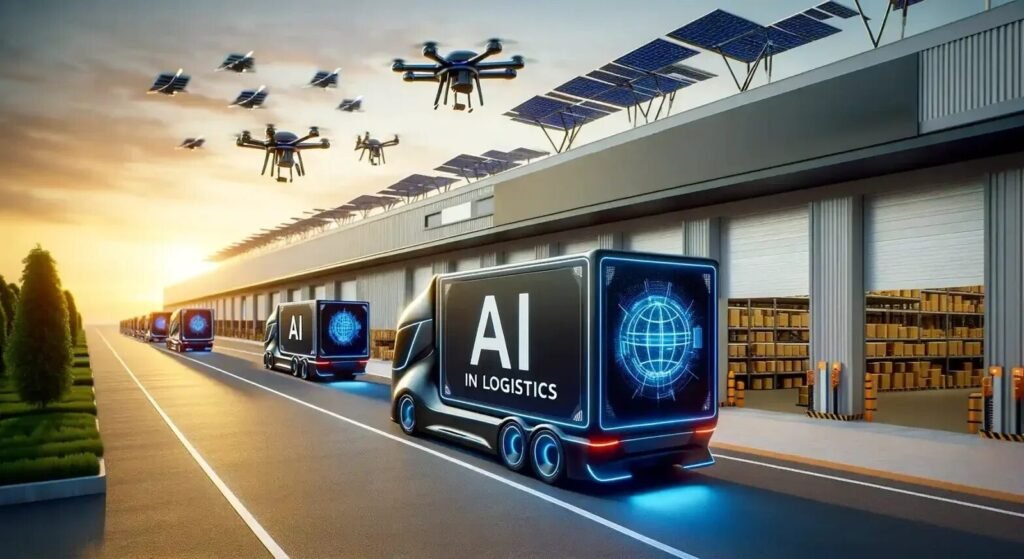
In the logistics industry, Artificial Intelligence (AI) is playing a central role in driving its transformation. From managing complex supply chains to automating warehouse operations and optimising transportation, AI is reshaping how goods move across the world. It enables businesses to predict demand, streamline operations, reduce costs, and make faster, data-driven decisions, creating supply chains that are smarter, more efficient, and highly responsive.
As global logistics continues to become more dynamic and interconnected, AI is helping organisations improve operational efficiency, enhance customer satisfaction, and respond quickly to changing market demands.
Present and Future of AI in Logistics
Artificial Intelligence has become a key pillar of modern logistics, helping businesses improve operational efficiency, reduce costs, and make smarter decisions. AI analyses both historical and real-time data to predict demand, optimise transportation, improve warehouse organisation, and provide complete product traceability by tracking the location, condition, and movement of goods throughout the supply chain.
With AI-powered systems, logistics professionals can accurately estimate delivery timelines, identify the most cost-effective transportation options, and quickly respond to disruptions such as supplier delays, weather conditions, or traffic congestion. As logistics networks become more complicated, AI enables firms to make faster, more accurate choices while maintaining good insight into their operations. Industry experts believe the future of AI in logistics is highly promising. As technologies continue to evolve, AI will not only automate repetitive tasks but also generate valuable insights that improve planning, operational efficiency, and overall supply chain performance.
For aspiring professionals looking to build expertise in this evolving field, logistics courses provide valuable knowledge of AI-powered technologies and modern supply chain practices that are shaping the future of the industry.
What Is the Future of AI in Logistics?
Artificial Intelligence is expected to transform logistics across three major operational areas.
- Warehouse Management
AI helps businesses improve warehouse productivity by forecasting customer demand, preventing stock shortages, optimising inventory placement, and reducing unnecessary movement inside warehouses. It also improves the efficiency of Autonomous Mobile Robots (AMRs), allowing warehouses to handle larger volumes with greater accuracy.
- Order Allocation and Distribution
AI intelligently allocates orders to the most suitable warehouse or distribution centre by analysing inventory levels, customer locations, transportation availability, and delivery priorities. It also optimises delivery routes, reducing transportation costs while improving delivery speed and customer satisfaction.
- Strategic Decision Automation
Instead of relying on static planning methods, AI continuously analyses real-time information such as demand patterns, inventory levels, transportation capacity, supplier performance, weather conditions, and traffic updates. This enables businesses to optimise inventory management, capacity planning, and distribution network design while making faster and more accurate strategic decisions.
Tools Driving These Changes
AI Agents
AI Agents are intelligent systems designed to operate and make decisions autonomously within supply chain operations. They can negotiate supplier contracts, reassign inventory between distribution centres, reroute deliveries, alert customers about shipment delays, and optimise logistics operations with minimal human intervention.
Generative AI (GenAI)
Generative AI (GenAI) creates content such as text, images, videos, and code on demand. In logistics, it can generate inventory reports within minutes, prepare operational summaries, create warehouse documentation, and even design intelligent 2D and 3D warehouse layouts that maximise storage utilisation and improve material flow.
AI-Driven Warehouse Management
AI-powered Warehouse Management Systems (WMS) have become a turning point in modern logistics. By combining machine learning and Generative AI, these intelligent systems transform operational data into actionable insights that improve warehouse efficiency and support faster decision-making.
Some of the major applications of AI in warehouse management include:
- Accurate demand forecasting using historical and real-time data
- Inventory optimisation to prevent overstocking and stock shortages
- Intelligent storage allocation for maximum warehouse utilisation
- Improved picking accuracy and faster order processing
- Reduced travel time for warehouse operators and autonomous robots
- Real-time performance analytics for operational improvements
- Scenario simulation to evaluate different warehouse strategies before implementation
Many advanced warehouse management systems also feature conversational AI assistants that allow managers to retrieve reports, analyse warehouse performance, and make strategic decisions using simple natural language commands.
AI is Reshaping Supply Chain Management
Artificial Intelligence is enhancing every stage of supply chain management by improving efficiency, reducing costs, and increasing operational visibility.
1. Demand Forecasting
AI analyses historical sales data, customer behaviour, seasonal trends, and market conditions to accurately predict future demand, helping businesses maintain optimal inventory levels.
2. Route Optimisation
AI identifies the fastest and most cost-effective transportation routes by analysing traffic, weather, fuel costs, delivery schedules, and road conditions in real time.
3. Information Sharing
AI enables seamless communication between suppliers, warehouses, transport providers, and customers, providing complete visibility throughout the supply chain and improving collaboration.
4. Yard Automation
Vehicle scheduling, dock management, trailer movement, and loading operations, everything can be done easily by reducing waiting times and improving operational efficiency by using AI.
5. Warehouse Automation
AI-powered robotics automate picking, sorting, packing, and inventory movement, increasing productivity while reducing manual errors.
6. Streamlined Freight Bill Audit and Payment
AI automatically verifies freight invoices, detects billing discrepancies, validates transportation charges, and accelerates payment processing, improving financial accuracy while reducing administrative workload.
The Future of AI in Order Allocation and Distribution
Artificial Intelligence is transforming order fulfilment by integrating advanced machine learning algorithms into logistics operations.
AI continuously monitors inventory levels and automatically generates replenishment orders whenever stock falls below predefined thresholds, ensuring uninterrupted product availability.
It also selects the most suitable fulfilment centre based on inventory availability, customer proximity, transportation costs, and delivery timelines. This improves delivery speed while reducing logistics costs.
Self-learning AI models continue to improve order allocation strategies over time, allowing businesses to build increasingly adaptive and intelligent distribution networks.
AI and the Future of Automation
By incorporating AI, automation can be implemented throughout warehouses, transportation systems, and logistics operations.
Some of its most impactful applications include:
- Predictive Maintenance: Detects equipment issues before failures occur, reducing downtime and maintenance costs.
- Computer vision enables robots to recognise products, navigate warehouse environments, and improve operational accuracy.
- Traffic Coordination: Optimises movement for Autonomous Mobile Robots (AMRs) by assigning the fastest routes while preventing congestion and collisions.
- Machine Learning for Robotics: Allows robots to continuously improve their performance by learning from previous operations and adapting to changing warehouse environments.
These intelligent automation technologies are making logistics operations faster, safer, and more efficient than ever before.
Driving the Future of Logistics with AI
Artificial Intelligence is redefining logistics by automating processes, optimising transportation, improving warehouse management, and enabling smarter decision-making across the supply chain. As businesses continue to embrace digital transformation, AI will play an even greater role in creating logistics networks that are more efficient, resilient, sustainable, and customer-centric.
With AI becoming an essential skill in the industry, pursuing a Supply Chain Management and Logistics Course helps aspiring professionals gain practical knowledge of modern logistics technologies. But make sure to choose the Best Logistics Institute in Kerala to equip yourself with industry-relevant skills, hands-on training, and higher career opportunities.
Contact our experts today to know more about the course.